Strength alone does not make a hero. What makes Herakles endure is not that he was invincible. It is that he was broken, and kept going anyway.
He was the greatest of all Greek heroes, the son of Zeus and a mortal woman, a fighter of impossible monsters and a man who spent his life paying for one terrible act. His story is one of guilt, punishment, redemption, and in the end, something that no other mortal achieved: becoming immortal.
Born to Greatness, Cursed from Birth
Zeus, king of the gods, fathered a child with Alcmene, a mortal woman of Thebes. Hera, Zeus's wife, was furious. She sent two serpents to kill the infant in his cradle.
The baby Herakles strangled both snakes with his bare hands.
He grew up to be a warrior of extraordinary strength, but Hera never stopped hating him. She waited for the moment when she could do real damage.
The Madness That Changed Everything
As an adult, Herakles had a wife, Megara, and children. He was a hero respected across Greece. Then Hera struck: she drove him temporarily mad.
In his madness, Herakles killed his wife and children.
When he came back to his senses and understood what he had done, the horror nearly destroyed him. He went to the Oracle at Delphi to ask how he could ever atone for this act. The answer came back: serve King Eurystheus for twelve years and complete whatever tasks the king demanded.
The tasks became the Twelve Labors of Herakles.
The First Labor: The Nemean Lion
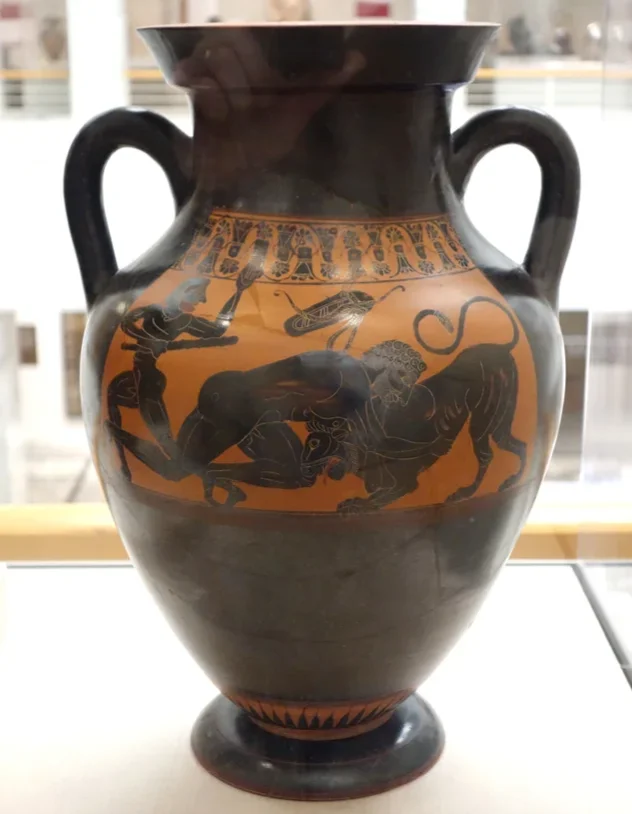
The lion of Nemea was no ordinary animal. Its hide could not be pierced by any weapon. Herakles tracked it to its lair in the hills and choked it to death with his bare hands. He skinned it using the creature's own razor-sharp claws.
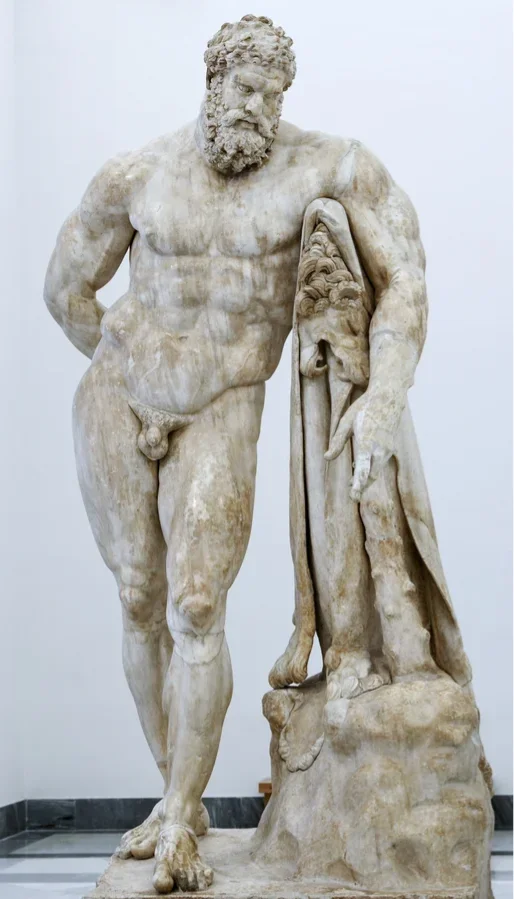
He wore that lion skin as armor for the rest of his life. It became his symbol: the unmistakable pelt draped over his shoulders, the club in his hand, the face of a man who had strangled the unkillable.
The Second Labor: The Lernaean Hydra
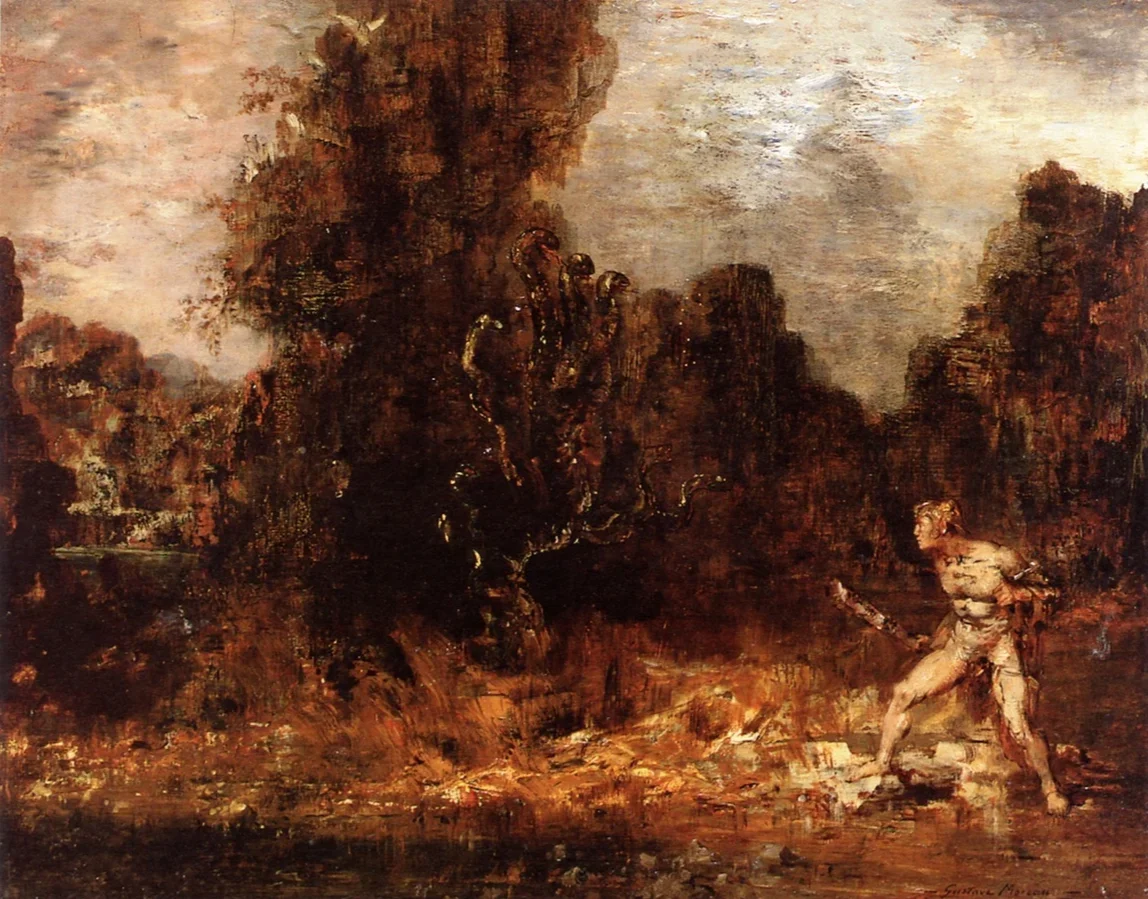
The Hydra was a water serpent with multiple heads and an infuriating ability: cut off one head, and two grew back in its place. Herakles and his nephew Iolaus solved the problem together. As Herakles cut, Iolaus burned each stump immediately with a torch, preventing regrowth. They destroyed the Hydra.
Eurystheus disqualified this labor because Herakles had help. The king kept finding reasons to add more tasks. Herakles kept completing them.
The Labors Continue
The remaining labors took him across the known world and beyond it. He captured the Erymanthian Boar alive. He cleaned the vast, filthy Augean Stables in a single day by diverting two rivers through them. He drove away the man-eating Stymphalian Birds. He captured the Cretan Bull, the Mares of Diomedes, and the golden Girdle of Hippolyta, queen of the Amazons. He stole the Cattle of Geryon from the edge of the world. He retrieved the golden Apples of the Hesperides from a garden guarded by an immortal serpent, briefly holding up the heavens in place of the Titan Atlas to accomplish this.
His final labor was the most frightening: descend into the underworld and bring back Cerberus, the three-headed dog that guarded the gates of death, alive and without weapons.
He did it. He brought Cerberus up to the surface and presented him to Eurystheus, who was so terrified he hid in a large bronze pot and begged Herakles to take the creature back.
The Death That Became an Ascension
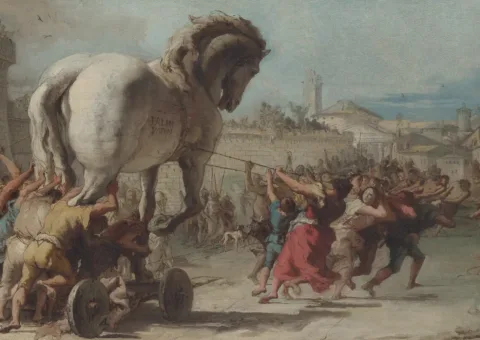
His labors were complete, but his story was not. He sailed with the Argonauts, helped the gods defeat the Giants, and sacked Troy. He married a second time, to a princess named Deianira.
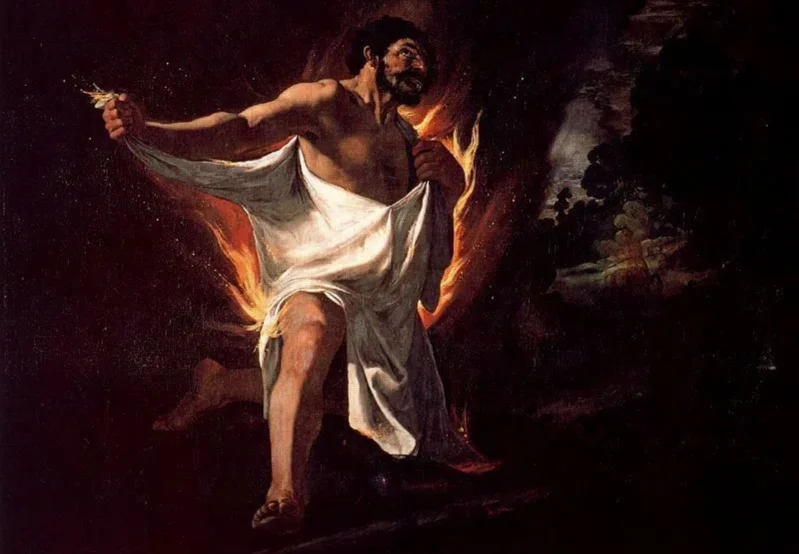
His death came not from a monster or a god but from a mistake. A centaur named Nessus, dying from one of Herakles's poisoned arrows, told Deianira that his blood would work as a love potion. It was a lie, and a trap. His blood was mixed with the same lethal poison.
Deianira, believing the centaur, soaked a shirt in the blood and sent it to Herakles as a gift. When he put it on, it burned into his flesh and could not be removed. In agony, Herakles built a funeral pyre on Mount Oeta, lay down on it, and asked his companions to light it.
But Herakles did not simply die in that fire.
The gods looked down. Zeus declared that his son had suffered enough. The mortal part of Herakles burned away. The divine part, the part that came from Zeus, rose up to Olympus. Herakles became a god. He was given immortality, married Hebe, the goddess of youth, and took his place among the immortals.
Why Herakles Still Matters
Herakles is not remembered simply because he was the strongest. He is remembered because his story says something true: that even the most catastrophic guilt can be faced, that punishment can become purpose, and that a person defined by violence can also be the one who makes the world safer.
He was flawed beyond measure. He was also, in the end, the only mortal in all of Greek mythology who earned a place among the gods.
Sources
Wikipedia, Heracles: https://en.wikipedia.org/wiki/Heracles
Wikipedia, Twelve Labours of Hercules: https://en.wikipedia.org/wiki/Labours_of_Hercules
Pseudo-Apollodorus, Bibliotheca: https://en.wikipedia.org/wiki/Bibliotheca_(Pseudo-Apollodorus)