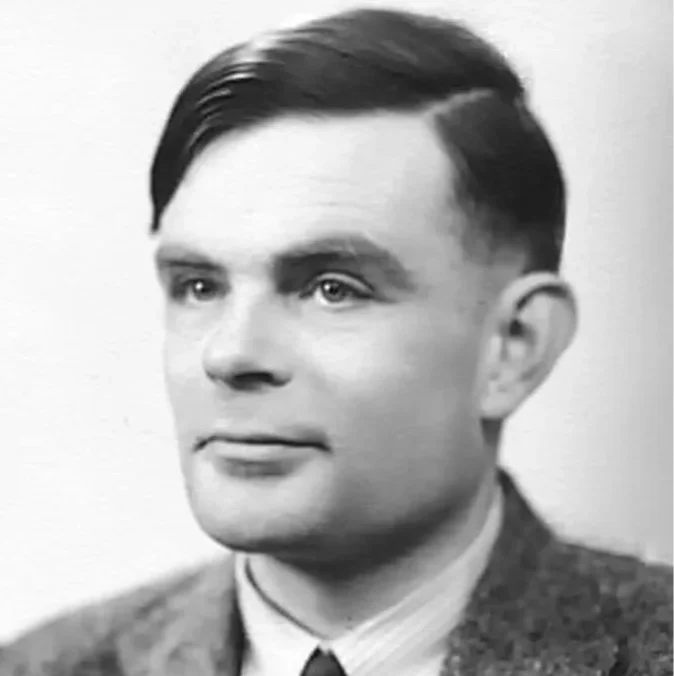
Alan Turing broke the Nazi code, helped end World War II, and saved an estimated fourteen million lives. The British government's thank-you was a criminal conviction, forced hormone injections, and a life cut short at 41.
Who He Was
Alan Turing was born in London on 23 June 1912. He showed signs of extraordinary mathematical ability from childhood, teaching himself calculus before the age of fifteen. At Cambridge, where he studied mathematics, he graduated with first-class honours. He was known to run to meetings rather than cycle, and reportedly ran a marathon in a time that would have qualified him for the 1948 Olympic Games.
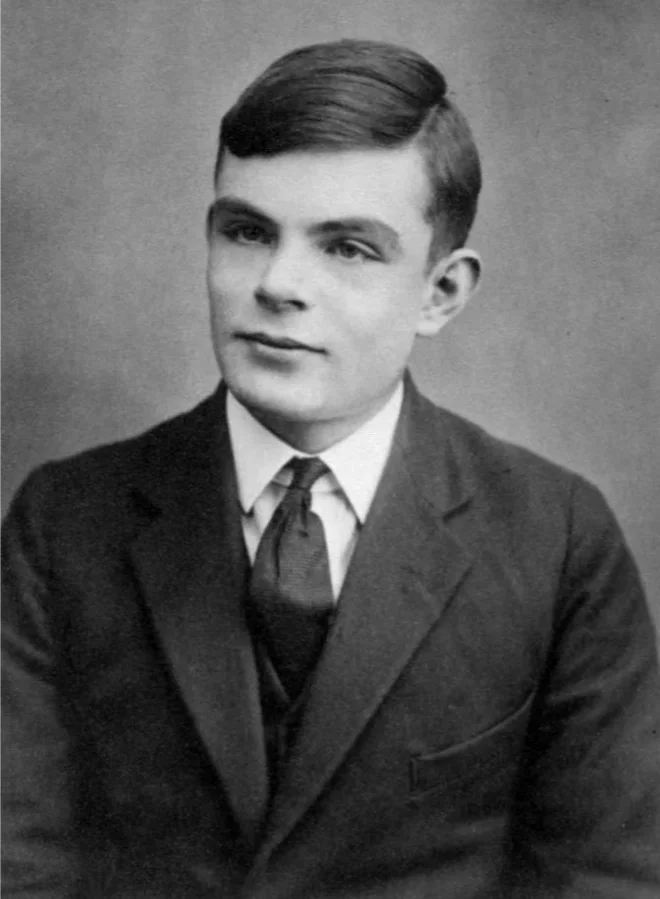
In 1936, aged just 24, he published a paper that invented the theoretical concept of computation itself. He described a hypothetical machine that could read instructions from a tape and execute any algorithm. He called it the Universal Turing Machine. It was not a real device. It was an idea. And it became the blueprint for every computer ever built.
He went on to study at Princeton under Alonzo Church, completing his PhD in 1938, just one year before the war changed everything.
What He Did During the War
In 1939, Turing joined Bletchley Park, Britain's top-secret codebreaking facility in Buckinghamshire. He was assigned to Hut 8, the team responsible for breaking German naval Enigma.
The Enigma machine was a mechanical cipher device used by the German military. It could encrypt a message in one of 159 quintillion possible configurations. That number is 159 followed by eighteen zeros. The settings changed at midnight every single day.
Polish mathematicians, led by Marian Rejewski, had already made the first breakthroughs before the war, building an early device called the Bomba. When they shared their findings with the British in 1939, Turing built on that foundation. His version was faster, more capable, and designed to handle the upgraded Enigma that Germany had introduced when war broke out.
He called his machine the Bombe.
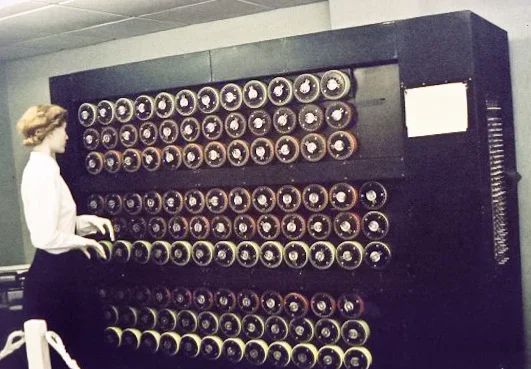
The Bombe worked by testing possible Enigma settings at speed, eliminating impossible configurations one by one. At its peak, 211 Bombe machines were running simultaneously across Britain. Together they decrypted up to four thousand messages a day.
Allied forces could read German U-boat positions in real time. Supply convoys were rerouted. Ambushes were avoided. The Battle of the Atlantic turned. Historians estimate that Turing's work shortened the war by two to four years and saved between fourteen and twenty-one million lives.
Winston Churchill later said Turing made the single biggest contribution to Allied victory of any individual.
After the War
After 1945, Turing turned his attention to building an actual computer. He designed the Automatic Computing Engine for the National Physical Laboratory, one of the earliest designs for a stored-program computer. He later moved to Manchester, where he worked on the Manchester Mark 1, an early operational machine.
In 1950, he published what would become his most famous paper: Computing Machinery and Intelligence. It opened with a question: Can machines think?
He proposed a test. Put a human and a machine in separate rooms. Have a judge hold text conversations with both, without knowing which is which. If the judge cannot reliably tell the difference, the machine has passed. Turing called it the Imitation Game. We call it the Turing Test.
In 2024, researchers found that GPT-4 convinced human judges it was human 54 percent of the time, exceeding the threshold Turing had imagined. The machines he theorised about have arguably passed the test he set for them.
In 1952, Turing also published a paper on morphogenesis, the mathematical processes that explain why a leopard has spots and a sunflower spirals the way it does. It was decades ahead of its time and is still cited in modern biology.
What Happened After
In 1952, Turing reported a break-in at his Manchester home to the police. During the investigation, he mentioned his relationship with a man named Arnold Murray. That was enough.
Homosexuality was a criminal offence in Britain under the 1885 Criminal Law Amendment Act, the same law used against Oscar Wilde fifty-seven years earlier. Turing was charged with gross indecency, convicted, and given a choice: prison or chemical castration through a course of synthetic oestrogen injections.
He chose the injections.
The treatment lasted a year. It caused physical changes and is reported to have affected his mental state. He lost his security clearance. He was barred from further government work.
On 7 June 1954, Turing was found dead in his home. A half-eaten apple lay beside his body. The official inquest returned a verdict of suicide by cyanide poisoning. He was 41 years old.
The apple was never tested for cyanide. Some have suggested accidental poisoning from a cyanide electroplating experiment he kept at home. His mother believed it was an accident. Others have speculated it was a reference to his favourite fairy tale, Snow White, in which a poisoned apple plays a central role. No one knows for certain.
What He Left Behind
The Turing Award, given annually by the ACM since 1966, is the highest honour in computer science. It is often called the Nobel Prize of computing.
In 2013, Queen Elizabeth II granted Turing a posthumous royal pardon. In 2017, the Alan Turing Law extended posthumous pardons to approximately 65,000 men convicted of the same historical offences.
Since 2021, Turing's face has appeared on the Bank of England 50-pound note.
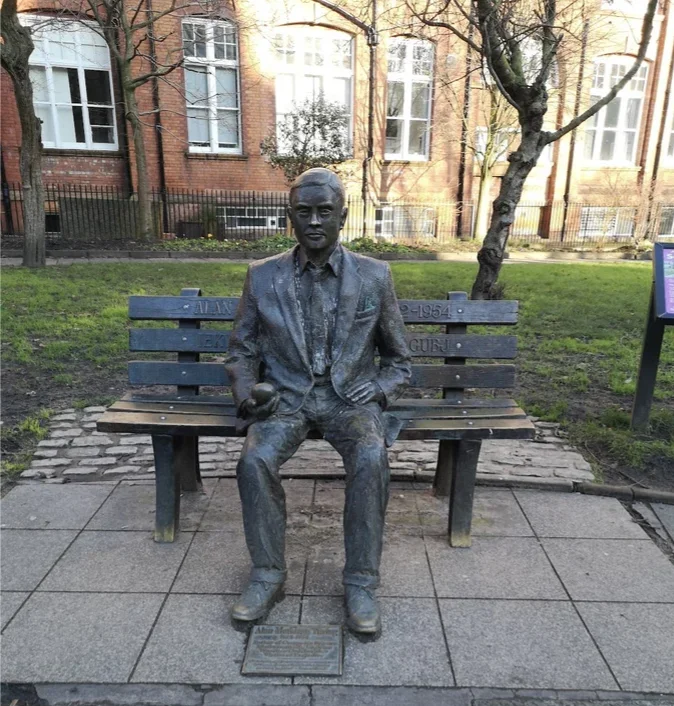
A bronze statue of Turing sits in Sackville Gardens in Manchester, close to where he lived and worked. He holds an apple.
In 2014, the film The Imitation Game brought his story to cinema audiences worldwide. In 2019, BBC viewers voted him the Greatest Person of the 20th Century.
What else might he have built, if they had left him alone?
In 2013, Queen Elizabeth II granted Turing a posthumous royal pardon. Better late than never, someone might say. Sixty years too late, someone else might say.
Both are right.
The codebreaking operations at Bletchley Park remained classified until the 1970s. The British government feared that revealing the extent of the intelligence advantage would expose ongoing methods. As a result, Turing and his colleagues received little public recognition during their lifetimes. Many went to their graves without ever being able to tell their families what they had actually done.
The Turing Test is a benchmark for machine intelligence proposed in Turing's 1950 paper. A human judge conducts text-based conversations with both a human and a machine, without knowing which is which. If the judge cannot reliably identify the machine, it is said to have passed. Turing estimated that by the year 2000 a machine would fool a judge thirty percent of the time. GPT-4 reportedly exceeded that threshold in 2024.
In 2009, Prime Minister Gordon Brown issued an official government apology, calling his treatment appalling and utterly unfair. In 2013, Queen Elizabeth II granted a posthumous royal pardon. In 2017, the Alan Turing Law extended posthumous pardons to all men convicted under the same historical laws in England and Wales.
At the time of his death, Turing was 41 and still producing original research. He had already invented the concept of computation, helped win a world war, founded the field of artificial intelligence, and published pioneering work in mathematical biology. What he might have built in a second career remains one of science's great unanswered questions.
Sources
Wikipedia, Alan Turing: https://en.wikipedia.org/wiki/Alan_Turing
National WW2 Museum: https://www.nationalww2museum.org/war/articles/alan-turing-betchley-park
British Legion: https://www.britishlegion.org.uk/get-involved/remembrance/stories/alan-turing-legacy
Built In, Turing Test: https://builtin.com/artificial-intelligence/turing-test