In 1150, somewhere in the Rhineland, an abbess sat down and invented a language. Not a cipher, not a code, not a simplified dialect. A language: its own grammar, its own vocabulary of nearly a thousand words, its own alphabet of twenty-three letters she called the Litterae Ignotae. She wrote it down, used it in at least one known song, and then continued with the rest of her life, which was already so full of accomplishment that the language has often been treated as a footnote.
Her name was Hildegard von Bingen. She was sixty years old when she created it.
The Life Before the Language
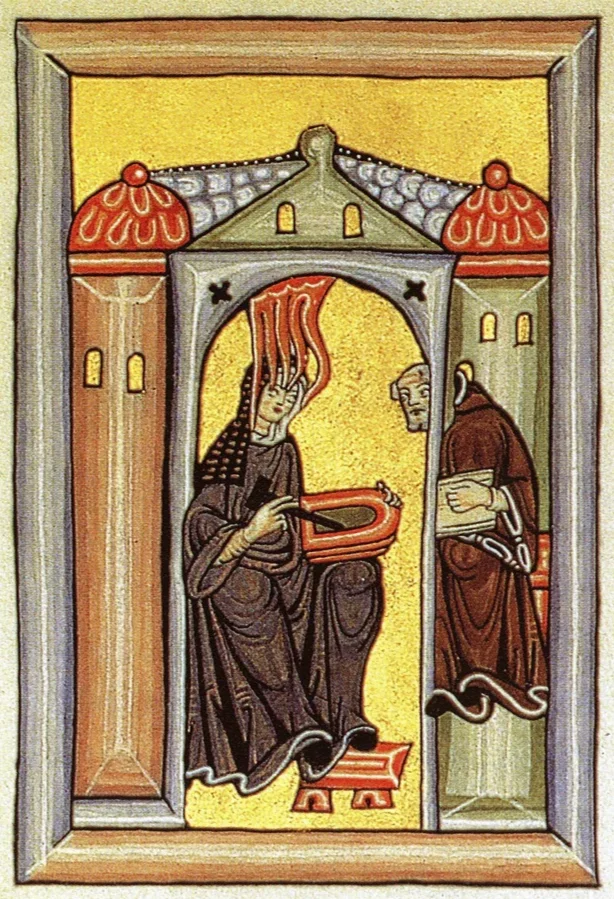
Hildegard was born in 1098 in Bermersheim vor der Hohe in the Rhineland, the tenth child of a noble family. At age eight she was given as a tithe to the church, a practice called oblation, and placed in the care of a woman named Jutta of Sponheim, an anchoress who lived in a small enclosure attached to the Benedictine monastery of Disibodenberg. Hildegard grew up learning to read, write, and sing the Psalms. When Jutta died in 1136, Hildegard was elected by the other women in the enclosure to succeed her as prioress.
She was thirty-eight years old and had been confined to monastic enclosure for thirty years. She had also been having visions since childhood, a fact she kept almost entirely to herself.
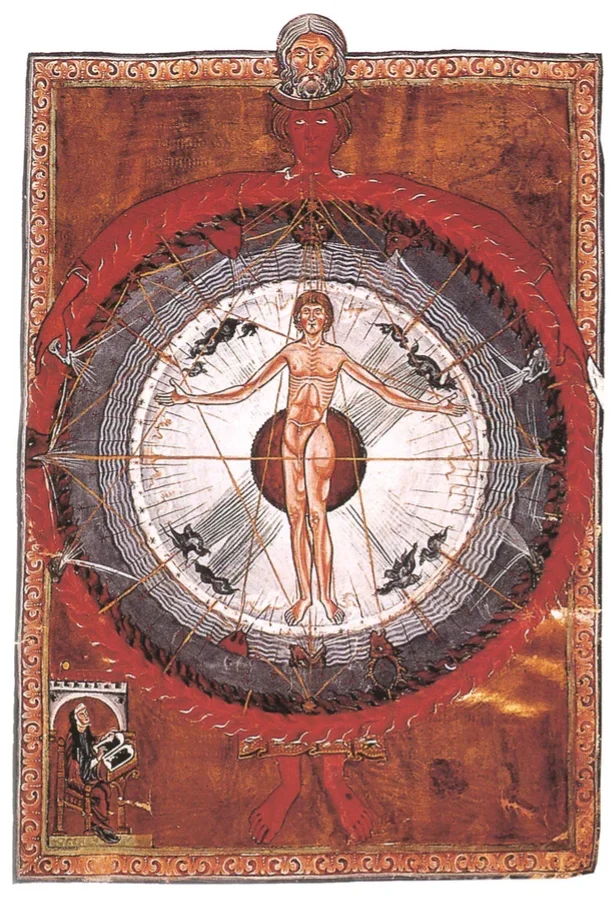
In 1141 she reported receiving a divine command to write down what she saw. She hesitated for years, tormented by self-doubt and what she described as a prolonged illness that lifted only when she finally began to write. The result was the Scivias, a vast theological work completed over a decade, containing thirty-five visions with detailed commentaries. It was read aloud before a synod at Trier around 1147-1148 and received the approval of Pope Eugenius III, who had Bernard of Clairvaux examine it. This was extraordinary. Hildegard was a woman with no formal academic training endorsing visions of cosmic scope, and the most powerful ecclesiastical authority in Europe had declared her work orthodox.
What She Did With the Rest of Her Time
The Scivias was not a single project she returned to after other business. It was one of several simultaneous undertakings.
Hildegard founded not one but two monasteries. She moved her community from Disibodenberg to Rupertsberg near Bingen around 1150, against the active resistance of the abbot of Disibodenberg, who did not want to lose the prestige and income her community brought him. She founded a second monastery at Eibingen across the Rhine in 1165. She conducted four preaching tours through the Rhineland, speaking publicly in churches and marketplaces at a time when women were not permitted to preach. She corresponded with emperors, popes, kings, abbots, and abbesses across Europe, and her letters were preserved and copied as models. The Holy Roman Emperor Frederick Barbarossa sought her counsel. She wrote back to him without apparent deference.
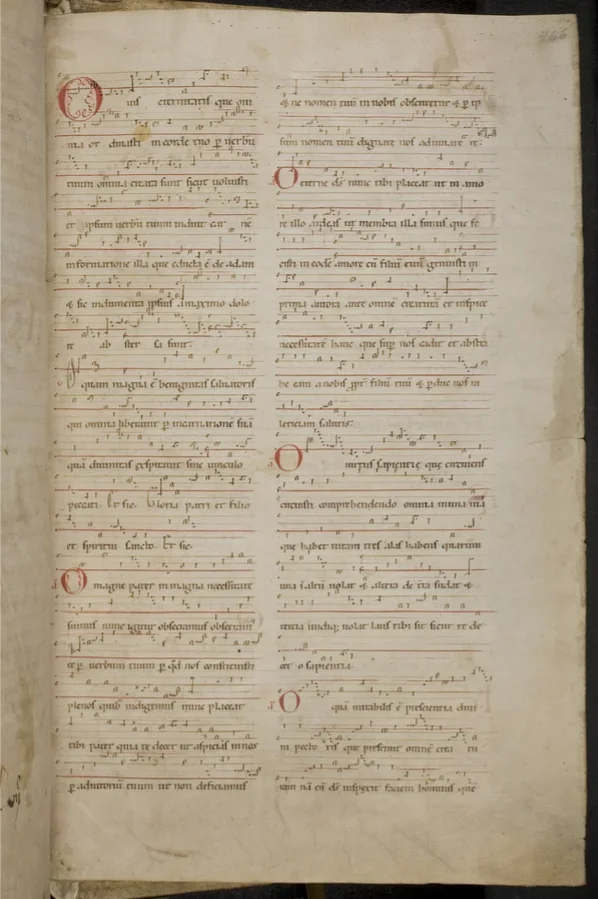
She composed eighty-two known musical works, more than any other composer from the medieval period whose name we know. Her cycle the Symphonia armoniae celestium revelationum contains antiphons, responsories, sequences, and hymns of unusual melodic range and ambition, with intervals and structures that do not follow standard Gregorian conventions. She also wrote a morality play, the Ordo Virtutum, which contains singing roles and a speaking role for the Devil, on the theological grounds that the Devil cannot sing.
She wrote two major works of natural science and medicine: the Physica, an encyclopedic description of plants, animals, stones, and their medicinal properties; and the Causae et Curae, a work of medical theory that integrated humoral medicine with her own observations. She described the human body in terms of four humors but also included detailed accounts of female anatomy, menstruation, and sexuality that are unusual in medieval medical writing.
The Lingua Ignota
Somewhere in the middle of all this, she invented a language.
The Lingua Ignota survives in two manuscripts. The primary source is the Riesencodex, the Giant Codex, a massive collection of Hildegard's works assembled at Rupertsberg after her death and now held at the Hessische Landesbibliothek in Wiesbaden. It contains a word list of 1011 words in the Lingua Ignota alongside their Latin and Middle High German equivalents. A smaller list of 880 words appears in a second manuscript at the Berlin State Library.
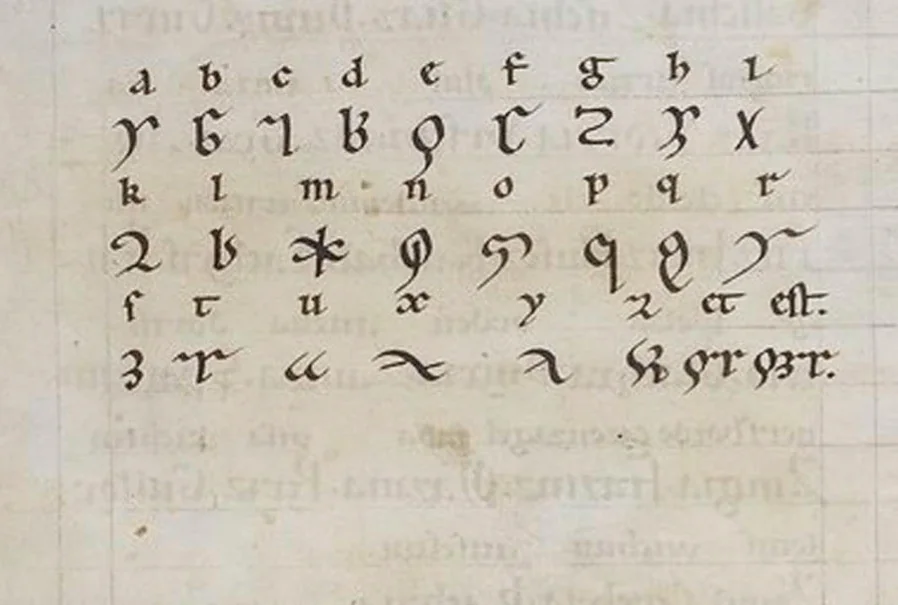
The alphabet, the Litterae Ignotae, consists of twenty-three symbols used to write the words. It is not derived from Latin or any other known script. It appears to have been designed from scratch.
The vocabulary in the Riesencodex is organized hierarchically, beginning with words for God and angels, then words for humans according to their rank and occupation, then body parts, then animals, then plants, then stones. This is not the structure of a code designed to obscure meaning. It is the structure of a created cosmological system, a language designed to map the world in a particular order.
The word for God is Aigonz. The word for a human being is Inimois. The word for an angel is Aieganz. The word for love is Crizanta.
Only one piece of music survives that uses the Lingua Ignota: the antiphon O orzchis Ecclesia, which begins with words in the invented language before shifting to Latin. The phrase orzchis Ecclesia means large or immense Church.
Why She Made It
No document by Hildegard explains the purpose of the Lingua Ignota. The question has produced speculation for centuries.
One interpretation treats it as a private mystical language, a sacred tongue for communication between Hildegard and her closest sisters, or between humans and the divine, distinct from the corrupted languages of fallen humanity. The hierarchical vocabulary, beginning with God, supports this reading.
Another interpretation sees it as an organizational and mnemonic tool, a controlled vocabulary for Hildegard's encyclopedic projects in medicine and natural history. The structured word list resembles the ordering of her Physica.
A third interpretation notes that Hildegard often worked to establish independence and authority for her community, and a private language would give her network of correspondents a degree of textual privacy.
What is not in dispute is that she created it, used it, and embedded it in at least one piece of music that was performed and copied. It was not a private notebook entry. It was a working artifact of her intellectual and spiritual life, recorded in the same manuscript tradition that preserved her theology, her music, and her medicine.
What Came After
Hildegard died in 1179 at the age of eighty-one. She was canonized by Pope Benedict XVI in 2012 and declared a Doctor of the Church, the highest academic honor the Catholic Church awards, one of only four women to hold the title.
The Riesencodex that contains the Lingua Ignota is still in Wiesbaden. It weighs about fifteen kilograms. The word list begins on folio 461 and runs to folio 464, in a clear hand, the unknown words set down beside their translations with the same methodical care as everything else Hildegard committed to writing.
The language was never widely used. Its grammar, if it had a grammar, was never written down. It remains largely untranslatable beyond the word list. What Hildegard heard when she thought in it, no one can say.
Sources
Wikipedia, Hildegard von Bingen: https://en.wikipedia.org/wiki/Hildegard_of_Bingen
Wikipedia, Lingua Ignota: https://en.wikipedia.org/wiki/Lingua_Ignota
Wikipedia, Litterae Ignotae: https://en.wikipedia.org/wiki/Litterae_Ignotae
Wikipedia, Riesencodex: https://en.wikipedia.org/wiki/Riesencodex
Wikipedia, Symphonia armoniae celestium revelationum: https://en.wikipedia.org/wiki/Symphonia_armoniae_celestium_revelationum