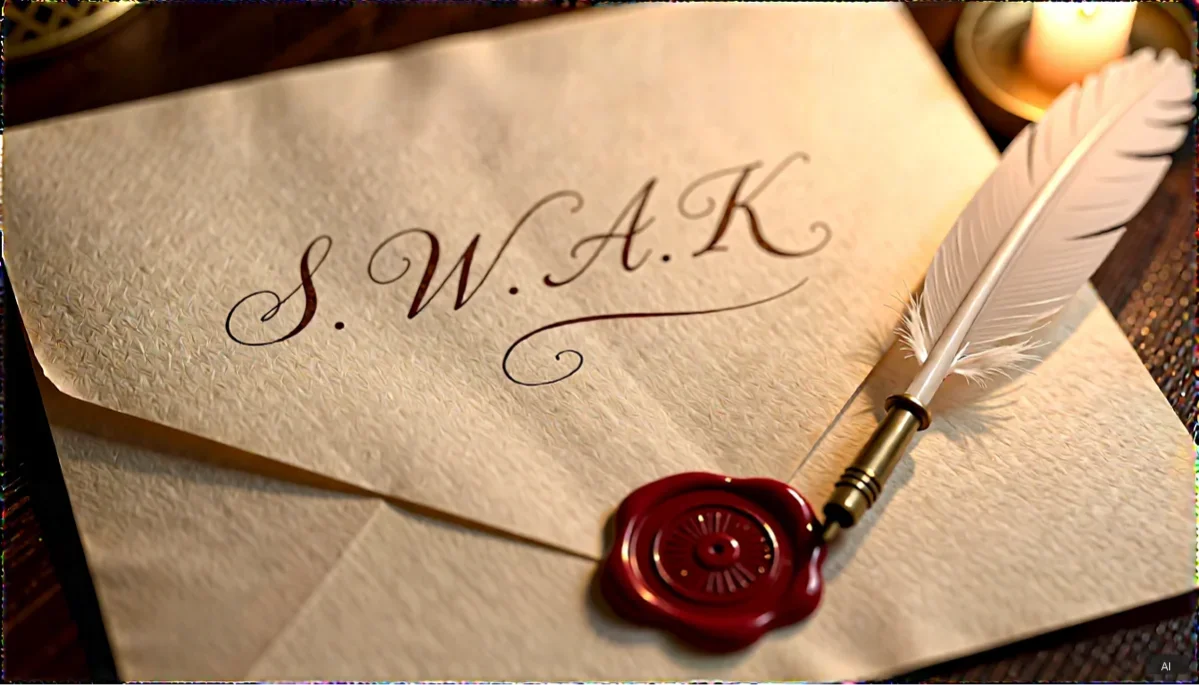
There is a scene in Outlander: Blood of My Blood that does something most television cannot manage. It makes a letter feel dangerous. The person writing it is not sending a message. They are placing something of themselves inside an envelope, folding it shut, pressing warm wax over the fold, and then sealing it, finally, with their lips.
S W A K. Sealed with a kiss.
The moment you see it, something in you recognizes it. Not as nostalgia exactly, because most people alive today have never sealed a letter with wax. But as a feeling that something has been lost, and that its absence is larger than you thought.
Where the Phrase Comes From
The abbreviation SWAK appears in letters exchanged between soldiers and their families and lovers during the First and Second World Wars. The conventions of wartime correspondence created a kind of private shorthand. SWAK meant that the writer had pressed their lips to the envelope before sending it. ITALY meant I Trust And Love You. HOLLAND meant Hope Our Love Lasts And Never Dies. BURMA meant Be Undressed Ready My Angel.
These abbreviations were a form of intimacy operating within the constraints of censorship and military mail. A soldier writing SWAK on the back of an envelope was putting something physical into a piece of paper that might travel ten thousand kilometers before being opened in a kitchen or a bedroom by someone who had no idea when they would see him again.
The practice of sealing letters with a kiss predates the abbreviation. For as long as people sealed letters with wax, they sealed them with wax they had warmed with their breath, pressed with their fingers, sometimes marked with a ring or a seal that was uniquely theirs. The SWAK written on a 1943 envelope was already an old gesture.
The Age of the Letter
The 18th century, when Outlander: Blood of My Blood is set, was the golden age of letter writing. It was also the golden age of the wax seal.
Before the adhesive envelope, which was not widely adopted until the mid-19th century, letters were folded into their own enclosures and sealed. A letter could not be read without breaking its seal. The seal was the letter's integrity. To break it meant you were reading something private. To receive an unbroken seal meant you were the first to open it.
Sealing wax was made from shellac, turpentine, and a coloring agent, typically red from vermilion or cinnabar. You melted it with a candle, let it drip onto the folded paper, and pressed your seal before it hardened. If you had a signet ring, you used that. If you did not, you used your thumb, or a coin, or nothing at all, leaving only the smooth dome of hardened wax.
The wax was warm when it was pressed. It held an impression for centuries.
What a Letter Did That a Message Cannot
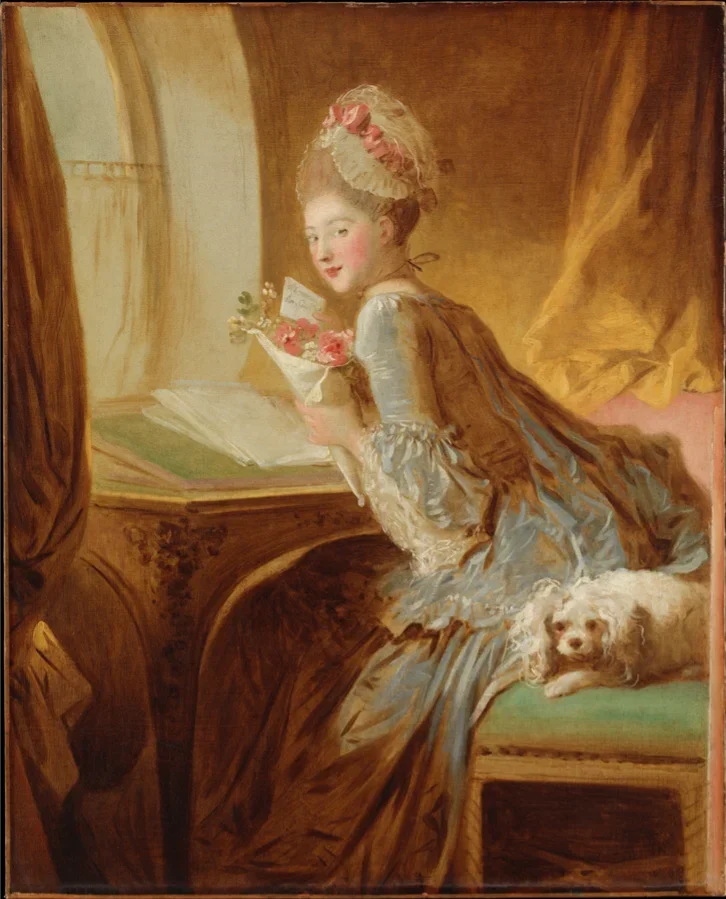
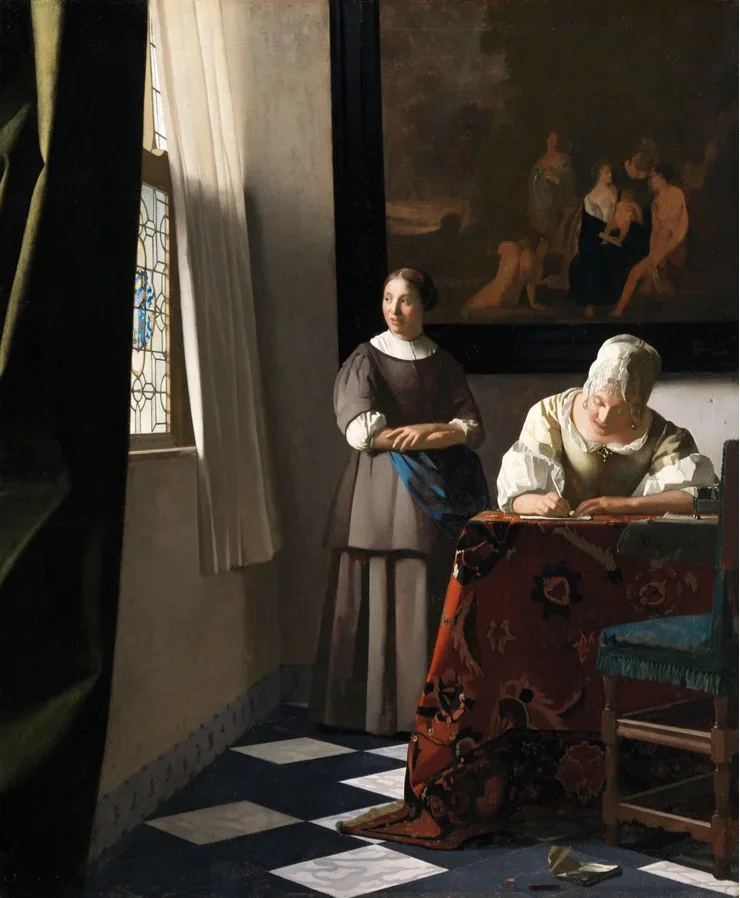
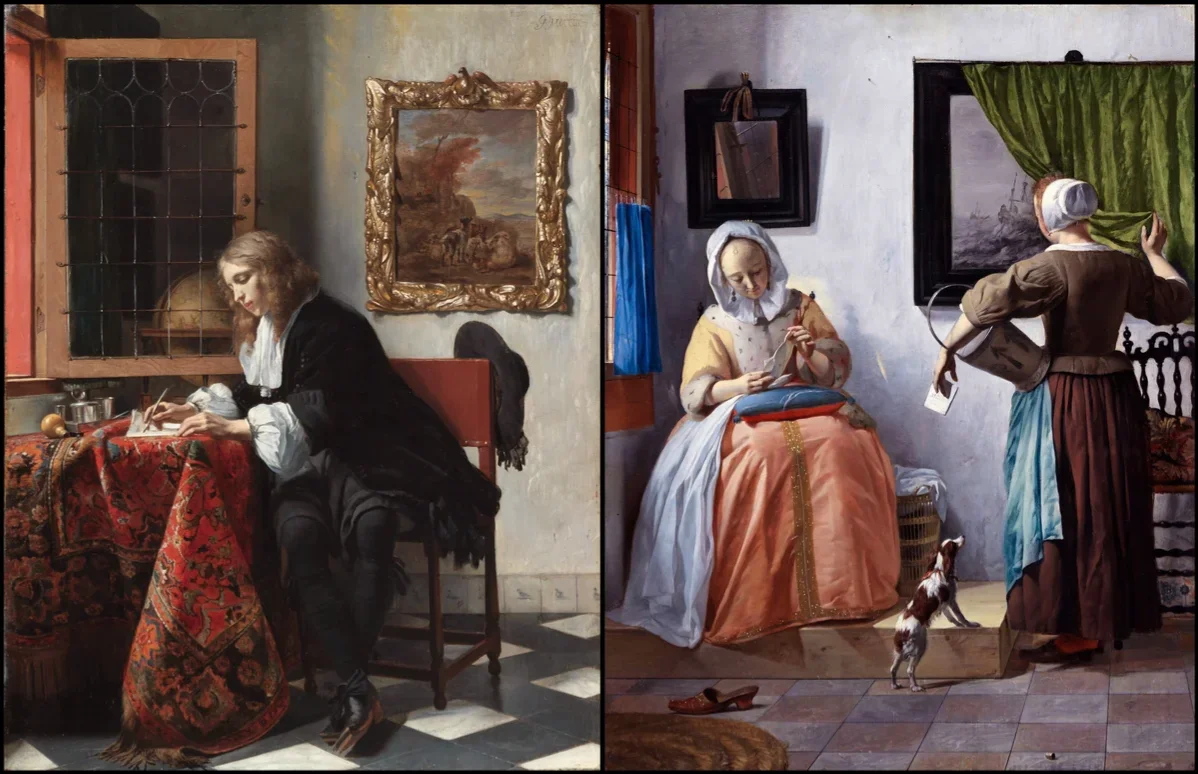
The painters of the 17th and 18th centuries understood something about letters that we have largely forgotten. Vermeer painted a woman writing a letter with her maid standing at the window. Fragonard painted a woman holding a note, her expression not quite readable, the paper light between her fingers. Gabriel Metsu painted the act in two halves: the man writing on one panel, the woman reading on another, connected by the same piece of paper across time and distance.
These painters kept returning to the letter because it contained everything that interested them: privacy, desire, time, the gap between what was written and what was meant.
A letter took time. You could not dash one off on a phone. You had to find paper, find a pen, find ink, sit down, and begin. The act of beginning was itself a decision. You were choosing to spend an hour in the company of the person you were writing to, even though they were absent. The letter was a form of visit.
It also left evidence. A letter could be kept. A letter could be read again, years later, in different circumstances. People kept letters from the dead. People kept letters from lovers they had left. A letter had weight, smell, the possibility of a thumbprint in the margin or a blot where the pen slipped. It was the physical trace of a moment of attention.
The Wax Seal Specifically
The seal said: this was closed by me and no one else. Breaking the seal said: I am the one you meant it for.
There was an entire vocabulary of wax seal imagery in use by the 18th century. A heart. A forget-me-not. A clasped hand. Initials. Mottoes in Latin. Some were tender. Some were formal. Some were a single word: Think of me. Remember. Forever.
Sealing wax in red had military associations. Sealing wax in black was for mourning. A seal could be a social signal before the letter was even opened.
To seal a letter with your lips, without a signet, without a device, was to put nothing between you and the paper except yourself. The warmth of the wax, the brief pressure, the trace of lip balm or breath or whatever the 18th century equivalent was. Not a mark that identified you by rank or family. A mark that identified you by body.
The abbreviation SWAK is, in that sense, a reduction of something much older to its most essential element. Not the seal. Not the ring. Just the kiss.
Why the Scene in Outlander Works
Outlander: Blood of My Blood is a prequel. It shows us the world before the world of the main series, the people who made the people we know. It is a show that understands that the 18th century was not simply the past. It was a world with its own technologies of intimacy, its own ways of transmitting feeling across distance and time.
The scene works because it does not explain itself. It does not cut to a character saying something about what sealing a letter means. It trusts the image. The wax melting. The press of the lips. The letter folded and ready to travel.
We are living in a moment when the gap between feeling something and transmitting it has been reduced to seconds. You can send a voice message while you are still thinking the thought. You can share a photograph of the thing you are looking at while you are still looking at it. The delay has been engineered out of communication almost entirely.
The wax seal was the opposite technology. It imposed delay. It required ceremony. It forced the question: is this worth sealing? And having decided yes, it offered a way of sealing it that was entirely physical, entirely personal, entirely unrepeatable.
S W A K. Sealed with a kiss. Four words that survived the transition from wax to paper to abbreviation to television, and still mean exactly what they always meant.
You pressed your lips to it. You meant it for someone. You let it go.
Sources
Wikipedia, SWAK: https://en.wikipedia.org/wiki/SWAK
Wikipedia, Sealing wax: https://en.wikipedia.org/wiki/Sealing_wax
Wikipedia, Jean-Honore Fragonard: https://en.wikipedia.org/wiki/Jean-Honor%C3%A9_Fragonard
Wikipedia, Johannes Vermeer: https://en.wikipedia.org/wiki/Johannes_Vermeer
Wikipedia, Gabriel Metsu: https://en.wikipedia.org/wiki/Gabriel_Metsu
Outlander Blood of My Blood: https://allyouneedisharry.com/harrysblog/harrys-movie-check-outlander-blood-of-my-blood-2025