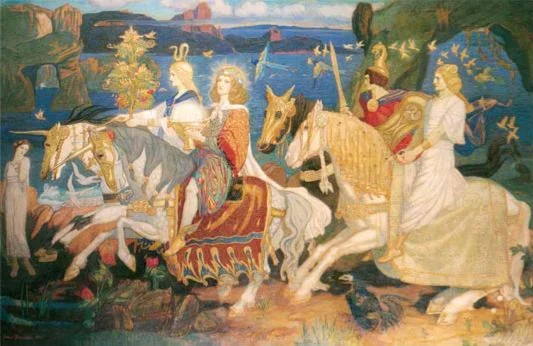
Before the Irish were Irish, the island belonged to a race of gods. The Tuatha De Danann, whose name means the peoples of the goddess Danu, arrived in Ireland shrouded in mist and cloud, settling on the sacred mountain of Sliabh an Iarainn. They were not ordinary settlers. They carried with them four treasures that could not be replicated by any mortal craft: the Spear of Lugh, which never missed its mark; the Sword of Nuada, from which no one could escape once it was drawn; the Cauldron of the Dagda, which left no one hungry; and the Lia Fail, the Stone of Destiny, which screamed when the rightful king of Ireland stood upon it.
Who They Were
The Tuatha De Danann were the divine race of pre-Christian Irish mythology, a pantheon of gods and supernatural beings who ruled Ireland before the coming of the Gaels. They were skilled in magic, craftsmanship, healing, and warfare. They are not presented in the medieval Irish texts as simple nature spirits or distant creator gods. They are individuals with personalities, ambitions, rivalries, and tragedies, closer in spirit to the Greek or Norse pantheons than to vague animistic forces.
Their origins are uncertain even within the mythology. One tradition holds that they came from four great cities to the north of the world: Falias, Gorias, Murias, and Finias. In each city they learned a different branch of druidic knowledge, and from each city they brought one of the four treasures. Another tradition connects them to the continent or to a celestial realm, but the northern cities account is the most widely preserved.
The Two Battles of Mag Tuired
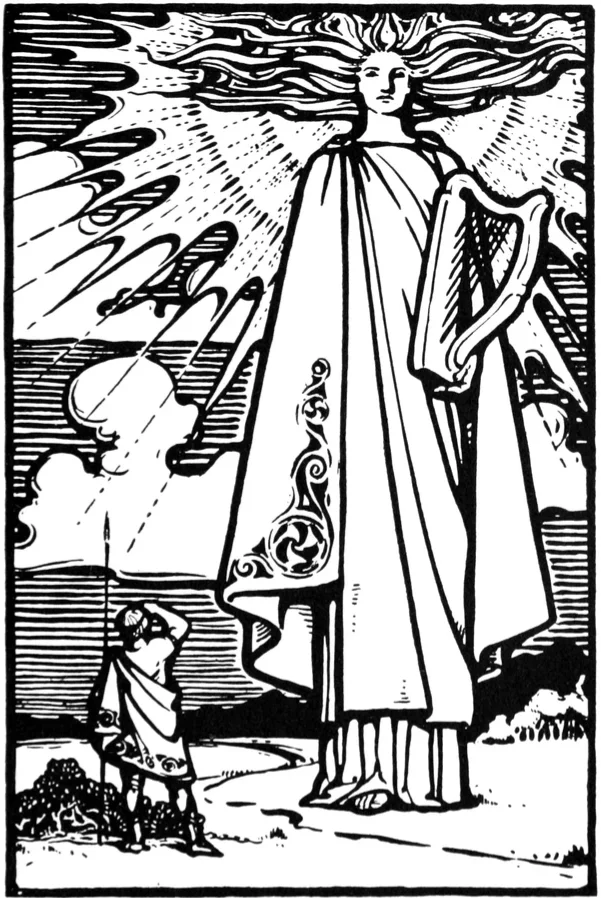
The Tuatha De Danann came to power in Ireland through two decisive battles, both fought at a place called Mag Tuired, the Plain of Pillars.
The first battle was against the Fir Bolg, the previous inhabitants of Ireland. The Tuatha De Danann won, but their king Nuada lost his arm in the fighting. Because a king of Ireland was required to be physically perfect, Nuada was deposed. His physician Dian Cecht crafted him a working arm of silver, earning him the title Nuada of the Silver Hand, and eventually a healer named Miach grew him an arm of flesh and blood, restoring him fully to kingship.
During Nuada's absence, the Tuatha De Danann were ruled briefly by Bres, a king of mixed ancestry who proved oppressive and humiliating to his people, forcing even great gods to perform menial labor. When Nuada was restored, Bres was deposed, and he fled to the Fomorians, the dark supernatural race who were the Tuatha De Danann's ancient enemies.
The second battle was against the Fomorians, who came in force under their king Balor of the Evil Eye. Balor's eye could kill entire armies with a glance when its lid was raised. It was Lugh, the young sun god and master of all skills, who killed Balor by driving a projectile through his eye from behind, turning its destruction back upon the Fomorian forces. This second battle secured the Tuatha De Danann as the rulers of Ireland.
The Major Figures
The Dagda was the father god of the Tuatha De Danann, owner of the inexhaustible cauldron and a great club that could kill with one end and revive the dead with the other. He was associated with abundance, wisdom, and the earth.
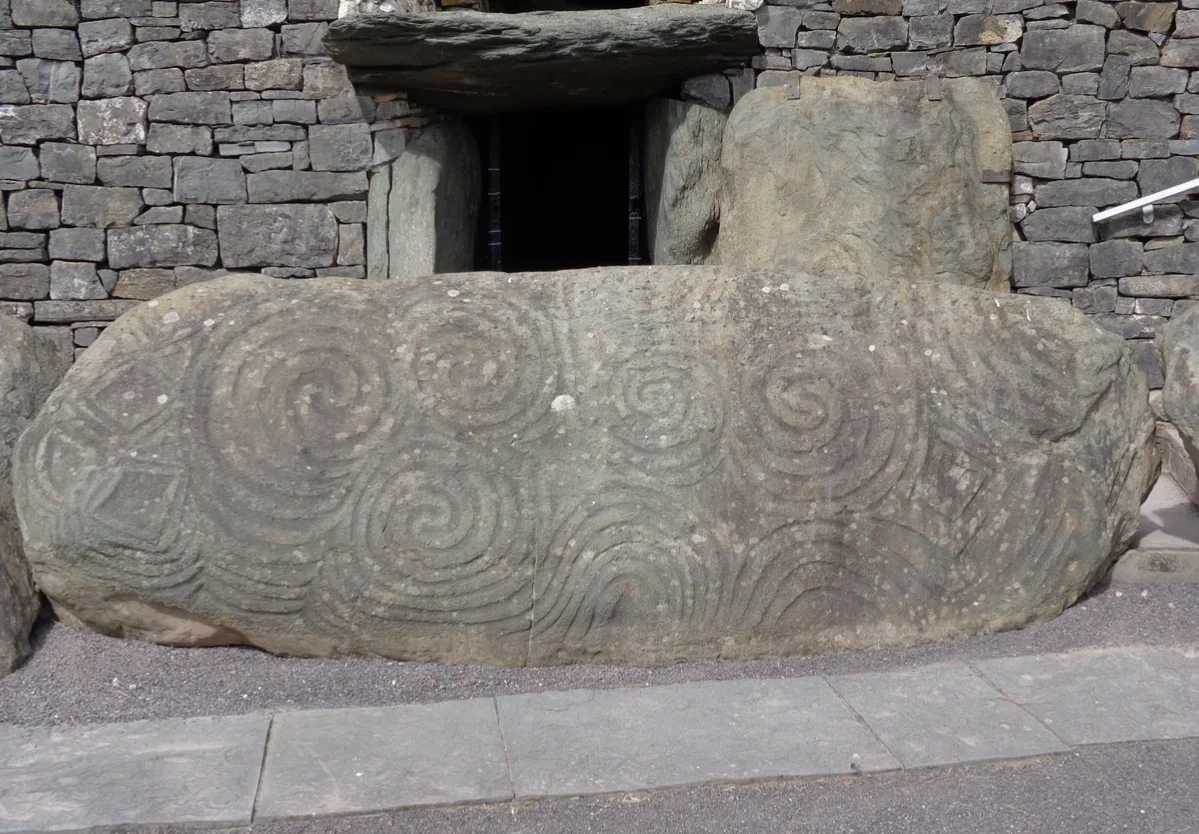
Lugh Lamhfhada, Lugh of the Long Arm, was the master of every craft and skill. His festival, Lughnasadh, was one of the four great festivals of the Irish calendar, held at the beginning of August to mark the harvest. He is one of the few figures of the Tuatha De Danann who left traces in place names and festivals across the Celtic world.
The Morrigan was a goddess of fate, war, and sovereignty, often appearing as a crow on the battlefield or transforming herself to test warriors. She was not a single figure but a triple goddess, sometimes presented as three sisters: Badb, Macha, and Nemain. She is among the most complex figures in the mythology, associated with both death and the power that sustains life.
Brigid was the daughter of the Dagda and goddess of healing, poetry, and smithcraft. She survived the Christianization of Ireland more completely than almost any other figure from the old mythology. Her festival, Imbolc, on the first of February, became Saint Brigid's Day, and Brigid herself was absorbed into the Christian tradition as a saint. Her sacred flame at Kildare was tended continuously until the Reformation.
The Otherworld
When the Gaels, the ancestors of the historical Irish, arrived in Ireland, they defeated the Tuatha De Danann in battle. The terms of the settlement are described in the medieval texts with some precision. Ireland was divided: the Gaels took the surface world, and the Tuatha De Danann retreated into the sidhe, the burial mounds and hollow hills beneath the earth, and to a realm called Tir na nOg, the Land of Youth, located beyond the western sea.
In this retirement the Tuatha De Danann became the Aos Si, the people of the mounds. They did not disappear from human life. They could intervene in the human world, grant gifts or inflict harm, and were to be respected rather than dismissed. The great megalithic monuments of Ireland, including Newgrange in County Meath, which was already two thousand years old when the mythology was composed, were identified as entrances to their underground realm or as their dwelling places directly.
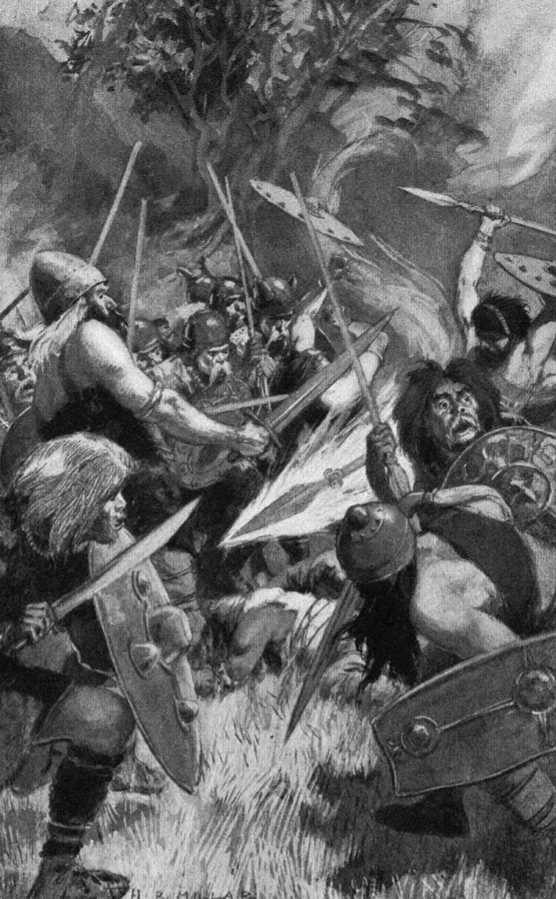
Newgrange in particular was held to be the home of the Dagda and later of Aengus Og, the god of love and poetry, who tricked his father out of it by asking to stay for a day and a night and arguing that a day and a night together constitute all of time. The passage tomb at Newgrange is aligned so that its interior is illuminated only at the winter solstice sunrise, a phenomenon that was not rediscovered by modern archaeologists until 1967.
What Survived
The Tuatha De Danann were never entirely suppressed by Christianity. The medieval monks who recorded the mythology did so with scholarly interest rather than simple hostility. The texts that preserve the mythological cycle, including the Book of Invasions and the Mythological Cycle proper, were compiled in monastic scriptoria and treated as historical sources about the early peoples of Ireland, not as dangerous pagan material to be destroyed.
The result is that the mythology survived in a form that is unusually detailed compared to the mythologies of other Celtic peoples. The Welsh tradition has the Mabinogion. The Gaulish tradition has almost nothing written down at all. The Irish texts give us something closer to what the tradition actually contained before the conversion, refracted through a Christian scholarly sensibility but not obliterated by it.
The Tuatha De Danann were eventually euhemerized in the later medieval tradition, reinterpreted as historical ancestors or gifted human beings rather than gods, as Christian theology required. But the stories survived, and the figures survived, and the landscape of Ireland is still covered with the sites the mythology gave them.
Sources
Wikipedia, Tuatha De Danann: https://en.wikipedia.org/wiki/Tuatha_D%C3%A9_Danann
Wikipedia, Riders of the Sidhe: https://en.wikipedia.org/wiki/Riders_of_the_Sidhe
Wikipedia, Newgrange: https://en.wikipedia.org/wiki/Newgrange
Wikipedia, Lugh: https://en.wikipedia.org/wiki/Lugh
Wikipedia, Dagda: https://en.wikipedia.org/wiki/Dagda
Wikipedia, Morrigan: https://en.wikipedia.org/wiki/Morr%C3%ADgan
Wikipedia, Battle of Mag Tuired: https://en.wikipedia.org/wiki/Battle_of_Mag_Tuired

